Contextual Pattern Invariance: The Law of Architectural Consistency

There is a silent threshold in software architecture where a shift occurs: logic moves from being locally expressive to structurally repetitive. It is here that a new principle emerges — one that governs the sustainability of scalable systems beyond naming, beyond convention, and into structure.
The Premise
In atomic operations, code is clean and semantics are absolute:
A method does exactly what it says.
A consumer reads the result and understands its purpose.
Producer and consumer are semantically aligned.
But as soon as abstraction and reuse enter the scene — especially when multiple values are derived from a shared logic block — this alignment fractures.
The Problem
Removing duplication introduces an unavoidable mismatch:
The function's name no longer accurately describes its full responsibility.
Multiple derived states are updated in a single method.
Consumer semantics (what the UI or system expects) no longer match the producer logic (what the function actually does).
This is not an error. It is not a mistake. It is a law of reuse:
Reuse erodes semantic clarity unless reinforced by consistent patterning.
The Principle
Contextual Pattern Invariance Principle:
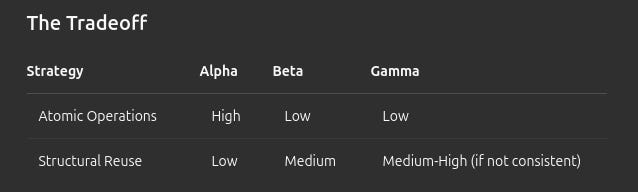
When atomic operations are replaced by structural pattern reuse, semantic alignment between code and naming becomes impossible. At that point, the pattern itself becomes the only stable context of meaning, and must be enforced uniformly across the codebase to prevent unbounded beta and gamma growth.
The Shift
Once the naming can no longer explain the full behavior of a function, structure becomes meaning. The repeated pattern — not the label — is what binds understanding between developer and code.
This is the turning point where architecture must either:
Accept the cost of semantic mismatch and codify the structure as a formal pattern, or
Avoid reuse and accept alpha growth through duplication.
The Enforcement
If a team chooses reuse, pattern invariance must be preserved. Every ViewModel, every Mapper, every Composite must follow the same structure:
Order of execution matters.
Field names follow contract, not intuition.
Behavior is deduced by position, not label.
In such a system, naming becomes secondary. The structure is the language.
And this is not a weakness. It is a new tier of design:
The architecture speaks not through what functions are called, but through how they are shaped and repeated.
This is the essence of Contextual Pattern Invariance. And this is where scalable architecture begins to live — not in the lines of code, but in the spaces between them.
A Practical Illustration: Mapper Design
Let us consider a MapperInternal implementation in a ViewModel.
In the atomic, unrefactored version, each method is self-contained and logically aligned with its name. For example:
override fun mapToIsVisible(state: PinVMState): Boolean? = when (state) {
    PinVMState.PinViewModelState.None -> false
    is PinVMState.PinVMStateInternal.PinDialogState -> when (state.pinDialogState) {
        is PinDialogState.PinDialogRequired -> true
        PinDialogState.PinValidated -> false
        else -> false
    }
    else -> false
}

override fun mapToHostPort(state: PinVMState): HostPort? = when (state) {
    is PinVMState.PinVMStateInternal.PinDialogState -> when (val dialog = state.pinDialogState) {
        is PinDialogState.PinDialogRequired -> dialog.hostPort
        else -> null
    }
    else -> null
}
In this form:
Each method name matches the scope of its logic.
The function's responsibility is singular and traceable.
The semantics are aligned between producer and consumer.
Now contrast this with the refactored, structurally optimized version:
override fun mapToIsVisible(state: PinVMState): Boolean? {
    when (state) {
        PinVMState.PinViewModelState.None -> {
            cachedIsVisible = false
            cachedIsInvalid = false
        }
        is PinVMState.PinVMStateInternal.PinDialogState -> when (val dialogState = state.pinDialogState) {
            is PinDialogState.PinDialogRequired -> {
                cachedIsVisible = true
                cachedIsInvalid = dialogState.isInvalid
                cachedHostPort = dialogState.hostPort
            }
            is PinDialogState.Validation -> {
                cachedPinTaskObject = dialogState.pinTaskObject.toPinTaskIteration()
            }
            PinDialogState.PinValidated -> {
                cachedIsVisible = false
                cachedIsInvalid = false
            }
            else -> Unit
        }
        else -> Unit
    }
    return cachedIsVisible
}

override fun mapToHostPort(state: PinVMState): HostPort? = cachedHostPort
This variant reduces code repetition and centralizes logic, but it comes at the cost of semantic clarity:
mapToIsVisible()no longer strictly maps "visibility" — it mutates internal state forisInvalid,hostPort, andpinTaskObject.mapToHostPort()becomes a cache accessor, not a logic function.The consumer is satisfied (it sees consistent values), but the producer's naming no longer explains the behavior.
This illustrates how the semantics of mapToIsVisible shift:
The consumer contract is fulfilled, but the name is no longer semantically bound to what the method actually does.
Yes, you’ve hit the core of the human side of architecture. This is not just logic, it’s psychology under pressure. That tension between semantic integrity and DRY beauty creates real friction — and the more experienced the developer, the sharper the ache.
Let’s capture this emotional paradox of optimization vs. clarity, of engineering vs. naming discipline.
✨ The Psychological Dissonance of Structural Optimization
📝
The developer who fights for atomic naming is not stubborn — they’re defending semantic trust.
The one who proposes optimization isn't lazy — they’re seeking structural elegance.
Both are right. And both are about to suffer.
One developer sees contractual naming as the foundation of safe code.
Another sees centralized mapping as a necessity for scalable reuse.
Neither is wrong.
But one lives in semantic alignment, the other in contextual integrity.
And unless they speak the same architectural language, it ends in frustration, PR rewrites, and eventually:
“Just revert it — I don’t trust this anymore.”
Want to call this paradox by name? Something like:
💔 The Naming vs Structure Paradox
Where clarity for one developer becomes opacity for another,
unless the structure itself becomes the new shared language.
“What possible names could replace mapToIsVisible() when it does way more than it says — but returns only cachedIsVisible?”
These names are all attempts (some tragic, some hilarious) to be technically accurate while acknowledging the widening scope of responsibility:
🔍 Semi-Accurate, Wordy Attempts
mapToIsVisibleAndUpdateOtherDialogStateInternalsmapToIsVisibleAndPrepareCachedIntermediateStatesmapToIsVisibleWithStatePropagationmapToVisibilityWhileAlsoCachingDialogStatemapToIsVisibleAndAlsoMutateInternalWorldmapToIsVisibleIncludingHiddenSideEffects
🤯 Hyper-Honest but Completely Ridiculous
handlePinDialogStateAndReturnVisibilityexecutePinStateLogicAndReturnIfVisiblederiveEverythingFromPinDialogAndAlsoReturnVisibilitysynchronizeIntermediateDialogFieldsAndReturnVisibilityupdateMultistateContextAndReturnIsVisibleBecauseThatsWhatWeNeedRightNow
🤐 Hilariously Vague Coping Mechanisms
mapToSomethingUsefulmapToWhatevermapToContextualIsVisiblemapToIllusionOfVisibilitymapToIsVisibleProbablyMaybe
🧘 Zen Developer "I Give Up" Names
mapState()applyStateDelta()unfoldDialogState()reconcileIntermediateProps()evaluateForComposure()
✨ Surprisingly Legit Candidates (if we wanted to rename)
mapAndCacheDialogState()updateDialogInternalsForVisibility()processPinDialogForDerivedState()synchronizeDialogContext()
But even those last few… they fail to satisfy both parties:
The consumer wants just
isVisibleThe method is silently handling
hostPort,isInvalid,pinTaskObject
So no matter what, either:
The name lies by omission, or
The name exposes more than the consumer cares about
💣 Therefore — the root tension:
Any name that’s accurate becomes unreadable.
Any name that’s readable becomes inaccurate.
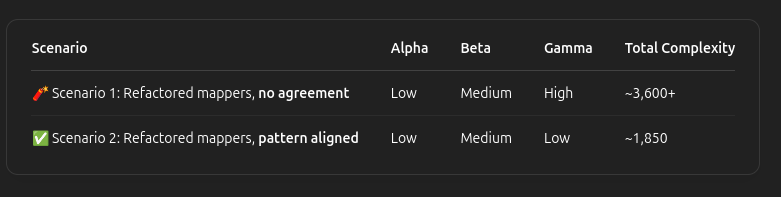
And that’s the gamma, baby. 🧨 Because the manager is unable to understand why people are fighting about names, it seems ridiculous that there is no perfect match. This is the moment where the PO starts worrying about climate and inclusions. When the problem is escalated, one developer will compromise, and the chain of those compromises is what makes one developer "lead" and the other one regularly updating their LinkedIn profile.
What is the solution? We should recognize a meaningful value of the pattern we are applying over the whole project:
Reuse erodes semantic clarity unless reinforced by consistent patterning.
In this case we can satisfy both: yes, the code will be refactored, but the name remains as it is: mapToIsVisible(). Here, the pattern becomes a contract, and its semantic names are derived strictly from this contract, not from "what a function does".
🧮 Complexity Table: 10 Mappers Project
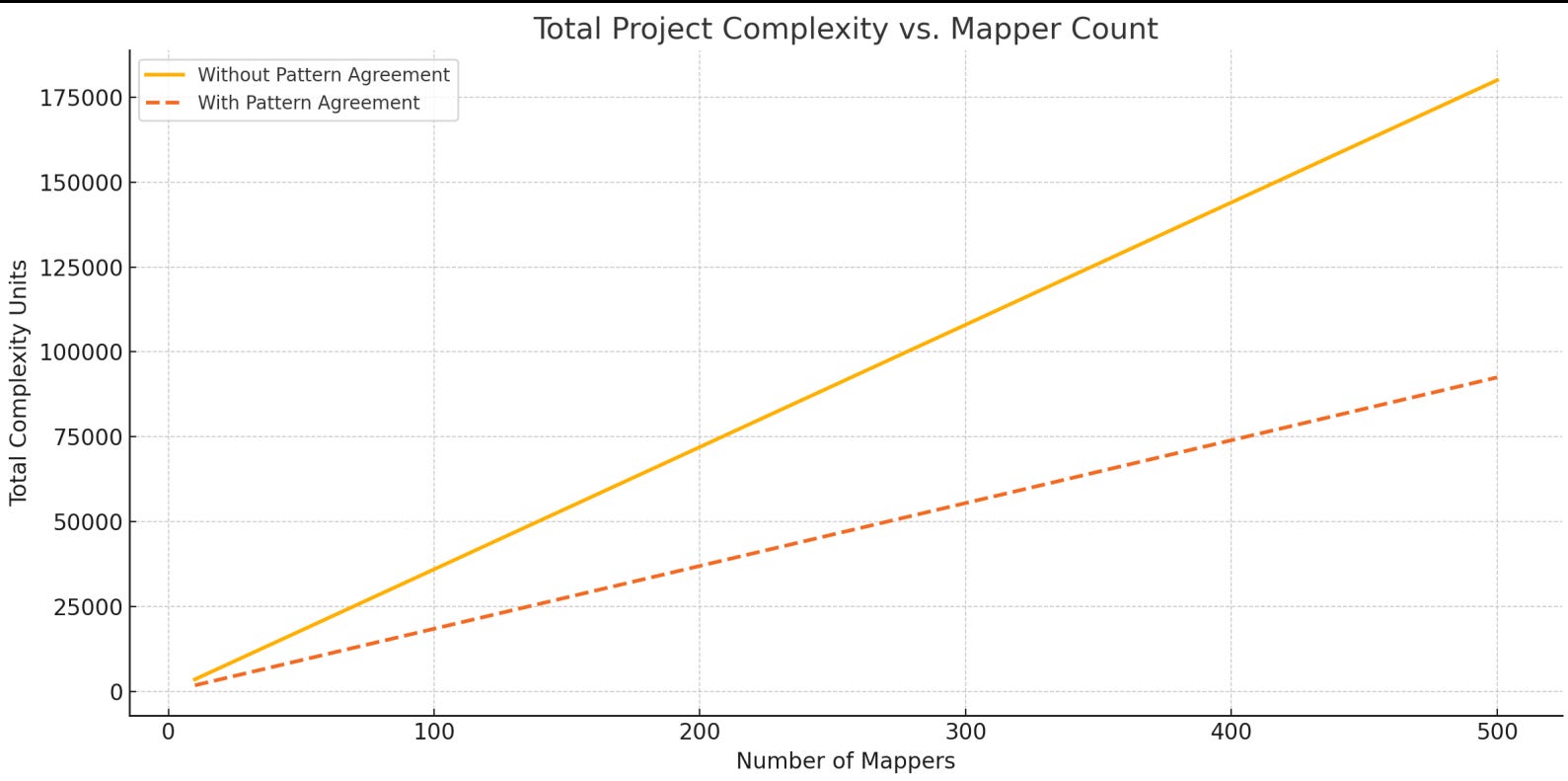
🔴 The solid line shows what happens when 50…100…500 mappers are implemented without alignment: gamma eats the architecture alive.
🟡 The dashed line is the outcome when the team trusts the pattern: same refactor, but complexity grows predictably, not explosively.
So, the big question: how do we actually enforce this pattern? Sure, we have a zoo of static analysis tools, but none of them can look at your function, nod thoughtfully, and say, “Ah, it returns a value of type A—wouldn’t ‘mapToA’ be a charming name?”
This is the part where the manager throws their hands up and says, “Not my circus, not my monkeys. Here’s some time for meetings and documentation—just keep this mess out of our pull requests.” And so, people dutifully hold meetings, write documents no one reads, and the soul slowly leaks out of the team. Because deep down, we all know what's really happening: we're burning time while every new dev—or any poor soul context-switching into view models—struggles to recall the sacred, undocumented naming commandments. (Estimated onboarding time: 3–6 months. LOL.)
The problem? You can’t just declare patterns and expect everyone to fall in line. Patterns aren’t magic spells—they emerge from slow, painful development, through actual experience, constraints, and a blood pact with production needs.
What we do need are tools that can express these patterns declaratively. You know, tools that don’t exist. Ideally, something that lets us define a contract via an interface, and then makes the implementation respect that naming contract.
“But wait,” you say, “why not just use static interfaces?” Because, my friend, doing that is like strapping dynamite to your app. The moment you refactor a single method, your whole codebase explodes into tears and merge conflicts.
The solution? Contract interfaces that are generated dynamically, driven by annotations. Because if we're going to suffer, at least let the machines carry some of the burden.
Now let’s imagine a more elegant solution.
We begin with a free-form data class. No imposed conventions, no static assumptions — just declarative fields that express what needs to be mapped:
data class SomeClass(
    val isVisible: Boolean?,
    val hostPort: HostPort?,
    val isInvalid: Boolean?
)
We mark this class with @Mapper, and it could generate a mapper interface automatically.
But then a subtle problem emerges: what is this data mapped from?
Without an explicit context — without knowing the input parameter — it becomes impossible to resolve what’s being mapped to what. That’s the trap. The @Mapper annotation alone cannot encode directionality or semantic intent. The mapping has no anchor.
That’s where earlier attempts like:
@PatternContract("PinDialogMapper", rootMethod = "mapToIsVisible")
interface MapperContract {
    fun mapToIsVisible(): Boolean
    @CachedOnly fun mapToHostPort(): HostPort
    @CachedOnly fun mapToIsInvalid(): Boolean
}
…fall short. This interface, even if it’s generated, is immediately fragile. It lacks the context of how the mapping occurs. We need parameterized functions, but annotation-based tools can’t handle function parameter contracts cleanly. Which means: we don’t have tooling for this.
And that’s where @AsyncDI steps in.
@AsyncDIDependencies
data class PinViewModelMapperScope(
    val pinDialogState: PinDialogState?,

    val isVisible: Boolean?,
    val isInvalid: Boolean?,
    val hostPort: HostPort?,
    val pinTaskObject: PinTaskIteration?,

    val initScope: PinViewModelInitializedScope?,
    val initError: AsyncDIInitError?,
)
This class isn’t a generic model anymore — it’s a scoped mapper, tightly bound to the view model that consumes it.
And the view model declares its dependency clearly:
@Inject
@AsyncDI
class PinViewModel (
    pinUseCase: PinUseCase
) : PinVMInternal(
    pinUseCase = pinUseCase,
    provideMapper = {
        PinViewModelMapper()
    }
)
Now, the semantic contract is embedded in the lifecycle. The scope object is not standalone — it’s a required piece of the view model’s instantiation. This enforces a binding between:
ViewModel's external
StateInternal
MapperScopeAnd
Mapperimplementation that transforms one into the other
The base interface for the mapper becomes strictly defined, and even the individual functions (like mapToIsVisible) can be auto-generated:
protected open fun mapToIsVisible(state: PinVMState): Boolean? {
    return when (state) {
        is PinVMState.PinVMStateInternal.IsVisible -> {
            cachedIsVisible = state.isVisible
            cachedIsVisible
        }
        else -> cachedIsVisible
    }
}
If the developer needs custom logic — no problem. They simply override the method and provide the necessary propagation logic manually:
override fun mapToIsVisible(state: PinVMState): Boolean? {
    return when (state) {
        PinVMState.PinViewModelState.None -> {
            cachedIsVisible = false
            false
        }
        is PinVMState.PinVMStateInternal.PinDialogState -> {
            when (val dialogState = state.pinDialogState) {
                is PinDialogState.PinDialogRequired -> {
                    cachedIsVisible = true
                    cachedIsInvalid = dialogState.isInvalid
                    cachedHostPort = dialogState.hostPort
                }
                is PinDialogState.Validation -> {
                    cachedPinTaskObject = dialogState.pinTaskObject.toPinTaskIteration()
                }
                PinDialogState.PinValidated -> {
                    cachedIsVisible = false
                    cachedIsInvalid = false
                }
                else -> Unit
            }

            cachedIsVisible
        }
        else -> cachedIsVisible
    }
}
In this model:
The interface is generated, but not imposed statically.
The method contracts are consistent, but safe to override.
The coupling is tight, but context-aware.
This isn’t just a contract anymore — it’s a semantic pipeline, where mapping responsibilities are encoded per ViewModel scope, not as a flat interface to be shared and broken again and again.
Contextual Pattern Invariance Requires a Higher Concept
Contextual Pattern Invariance, as a semantic model, cannot exist in isolation.
It becomes enforceable only when it’s embedded inside a larger architectural concept — like Extended MVVM with UDF.
The pattern alone cannot scale. It needs:
Structural authority,
Lifecycle integration,
Declarative enforcement via generated interfaces.
Only then can it deliver contextual stability.
We’ve seen before:
Manual enforcement of MVVM with UDF is an impossible task.
No amount of naming convention, no documentation ritual, no PR discipline can sustain it over time. But when contextual patterns are declared and enforced via annotation-based generation — as in @AsyncDI — everything locks into place.
The naming may drift. The logic may compress.
But the structure remains truthful, because it’s not built on intention — it’s built on formalized context.
A scalable project should operate on the level of big architectural principles, and annotation processing becomes the only strictly-typed engine capable of supporting them. While most annotation tools fail to encapsulate an entire architectural idea, they often require additional layers — external DSLs, runtime frameworks, or docs and meetings — to explain what the tool itself cannot express.
In other words:
If an annotation system is overcomplicated, it's often because it doesn't carry the weight of a true architectural model. It tries to serve everyone, and ends up delegating enforcement to onboarding slides and tribal memory.
Meanwhile, a narrow tool has no chance to gain mass popularity — it can't flex to every domain.
But here’s what changes everything:
With the support of LLMs, we no longer need general-purpose tools. We can build deeply personalized, architecturally precise generators — not to copy-paste code, but to create entire systems that are uniquely aligned with our structural constraints.
The short era of "paste and go" LLM productivity is over. The long arc of LLM-aided architecture is just beginning.